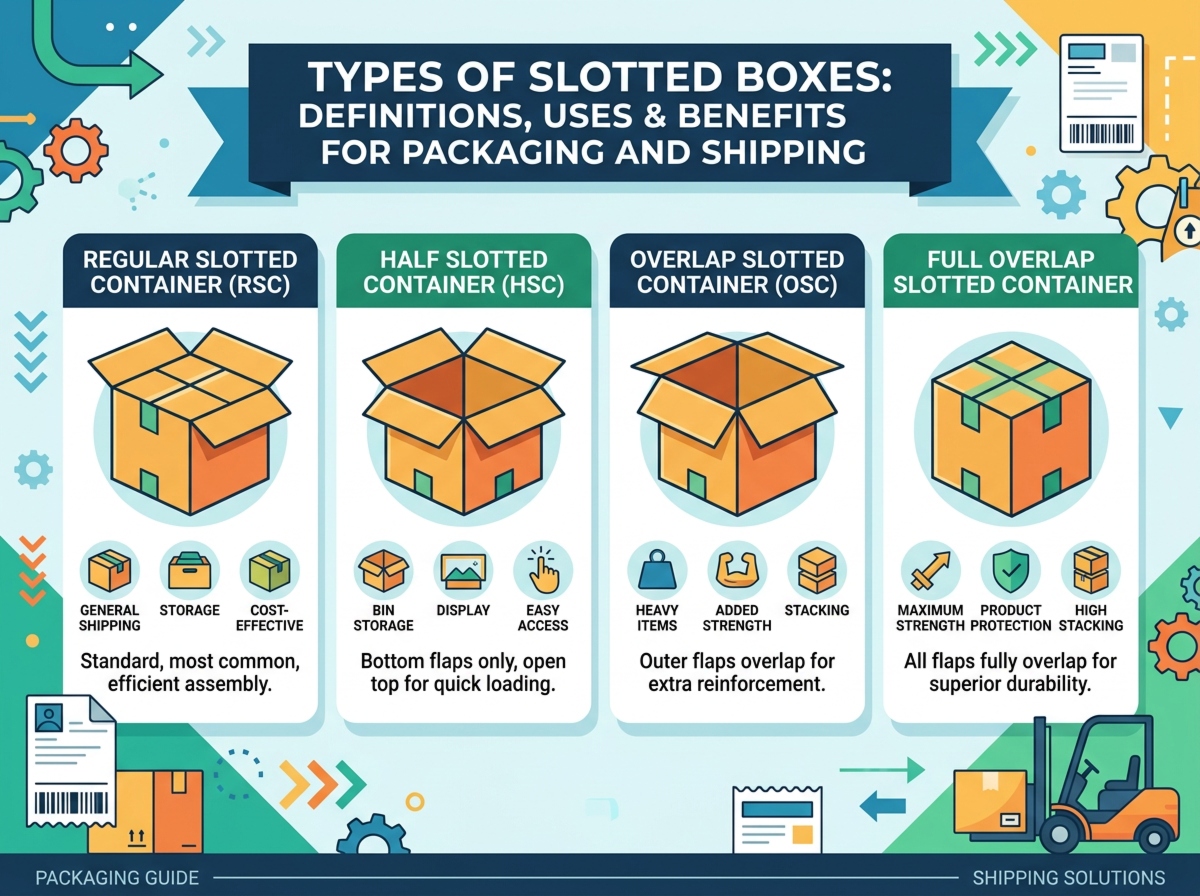
Slotted boxes come in several structural styles—RSC, HSC, OSC, FOL, and CSSC—and in corrugated packaging, structure defines performance: how well a box stacks, protects, and survives transport. An RSC keeps costs low, an HSC speeds up loading, while an FOL or CSSC withstands heavy stacking and long transit stress.
This guide explains each slotted box type with verified ASTM compression data and a clear application-fit matrix, so you can quickly match the right design to your product weight, shipping route, and warehouse demands.
What Is a Slotted Box?
A slotted box is a type of corrugated box made from one sheet of corrugated board. You fold the box along scored lines and close the flaps on top and bottom. In 2023, slotted boxes held over 51.0% of the corrugated boxes market share by type according to Grand View Research, “Corrugated Boxes Market Size, Share & Trends Analysis Report, 2024–2030“.
Manufacturers cut slots into the blank to create these flaps. Slotted boxes show up everywhere—shipping, storage, and retail packaging. Their simple design means you can set them up quickly and seal them easily.
Basic structure of a slotted box
- One flat blank of corrugated cardboard
- Four side panels connected by score lines
- Top and bottom flaps created by slots
- Closure with tape, staples, or glue
The flaps either meet at the center or overlap, depending on the style. You can tweak the strength and protection just by changing the flap design.
How a slotted box looks when folded
Common Types of Slotted Boxes
Slotted corrugated boxes use scored flaps that fold down to close the top and bottom. Each style changes flap length, overlap, or coverage, which affects strength, cost, and how easy they are to pack.
Regular Slotted Container (RSC)
A Regular Slotted Container (RSC) has four equal-length flaps with outer flaps meeting at the center seam when closed.
Because all panels are cut from a single sheet, board usage efficiency reaches about 97 %, making the RSC the most cost-effective corrugated design (ASTM D5118 specification).
Typical board grade is 32 ECT B-flute, supporting a compression load of ≈ 1 400 N under ASTM D642 testing.
Best use cases: general shipping cartons, e-commerce packaging, and warehousing boxes up to 20 kg.
Expert Tip: For additional product protection, use internal pads or corrugated inserts instead of thicker board.
Half Slotted Container (HSC)
A Half Slotted Container (HSC) removes the top flaps from a standard RSC, leaving an open-top access design.
Because the structure retains the same bottom closure, vertical strength remains about 85 % of an equivalent RSC (ASTM D642 load comparison).
This format allows fast manual loading and unloading during production or retail display.
Best use cases: in-process storage bins, point-of-sale displays, and packaging with separate lids or telescoping covers.
Typical construction: 32 ECT B-flute, recommended for loads up to 15 kg per container.
Expert Warning: If HSC is used for long-distance shipping or multi-stack warehousing,the open-top design becomes a structural weakness. Always pair it with a telescoping cover or lid, otherwise vertical load collapse is likely beyond RSC’s strength threshold during vibration or stacking stress.
Full Overlap Slotted Container (FOL)
A Full Overlap Slotted Container (FOL) has outer flaps that completely overlap when closed, forming a double-layer top and bottom panel.
Because of this overlap, compression strength of FOL increases by about 25–30 % compared with a regular slotted container of the same board grade ( According to ASTM D642 compression test).
The full flap coverage also reduces puncture risk during stacking or transit.
- Typical specification: 44 ECT C-flute or BC double-wall board — suitable for loads up to 30 kg per container.
- Best use cases: heavy machinery parts, export shipments, and high-stack warehousing.
Overlap Slotted Container (OSC)
An Overlap Slotted Container, or OSC has outer flaps that partially overlap the panel width.
Because the overlap reinforces the closure seam, compression strength increases by around 15–20 % compared with a Regular Slotted Container (ASTM D642 compression test).
This configuration provides a stable top surface for long or narrow boxes where standard flaps cannot meet in the center.
Typical specification: 32 to 44 ECT C-flute board; recommended load limit ≈ 25 kg per container.
Best use cases: furniture components, sports equipment, and irregularly shaped products requiring moderate stacking strength and cost efficiency.
Center Special Slotted Container
A Center Special Slotted Container (CSSC) has inner flaps that meet at the center and outer flaps that overlap halfway, creating a reinforced mid-panel.
Because load is distributed along both flap layers, center seam bowing decreases by 20–25 % compared with a Regular Slotted Container (RSC) under ASTM D642 compression tests.
Typical construction uses 44 ECT C-flute or BC double-wall boards, supporting stack loads up to 1 800 N without deformation.
Best use cases: flat or dense items such as glass panels, circuit boards, and automotive parts where even load distribution prevents mid-panel crush.
Comparison Table of Slotted Box Types
You can compare slotted box types by looking at flap design, strength, ideal use, and cost efficiency. This table focuses on common types of boxes used in shipping and storage. It also shows how they differ from telescoping boxes, which use a separate lid and base.
| Box Type | Flap Design | Strength | Ideal Use Case | Cost Efficiency |
| Regular Slotted Container (RSC) | All flaps same length; outer flaps meet at center | Standard | General shipping, e-commerce, storage | High |
| Half Slotted Container (HSC) | One set of flaps removed | Lower than RSC | Display packs, quick access | High |
| Overlap Slotted Container (OSC) | Outer flaps overlap fully | Higher than RSC | Heavy or fragile items | Medium |
| Full Overlap Slotted Container (FOL) | All flaps overlap | Very high | Long or narrow products | Medium |
| Center Special Slotted Container (CSSC) | Inner and outer flaps meet at center | Medium | Flat items, uniform loads | Medium |
| Telescoping Box | Separate top and bottom | High | Irregular or tall products | Low |
Flap design changes both strength and cost. When flaps overlap, you get more stacking strength and better impact resistance. When flaps just meet at the center, you use less material and save money.
Choose based on how you actually ship and store your products. If you care most about fast packing and low cost, RSC is usually the way to go. For heavy items, overlap designs bring better support.
How to Choose the Right Slotted Box for Your Product
Start with your product. Weight, size, and fragility all shape your choice. Heavy or fragile stuff needs higher stacking strength, while lighter goods can use simpler boxes.
Match the box style to your shipping process. A standard RSC box strikes a good balance between cost and strength. An HSC box works when you want to place products by hand or need easy top access during packing.
Don’t forget about corrugated flute types. They impact protection and box thickness in real ways.
- E flute: Thin and smooth; solid for small, light products
- B flute: Strong and crush-resistant; common for retail shipping
- C flute: Thicker and cushions better; great for heavier items
Surface treatments matter too. Lamination helps resist moisture and scuffs. Varnish boosts print quality. Kraft finish keeps things natural and gives basic protection.
Shipping conditions can tip the scales. Long transit times, warehouse stacking, or mixed freight mean you’ll want stronger corrugated walls and tight flap closure.
Sustainability is worth considering. Most slotted boxes use recyclable corrugated fiberboard. Right-sizing the box cuts down on material use and void fill, which trims waste and shipping costs.
Here’s a quick reference to match your needs with box features:
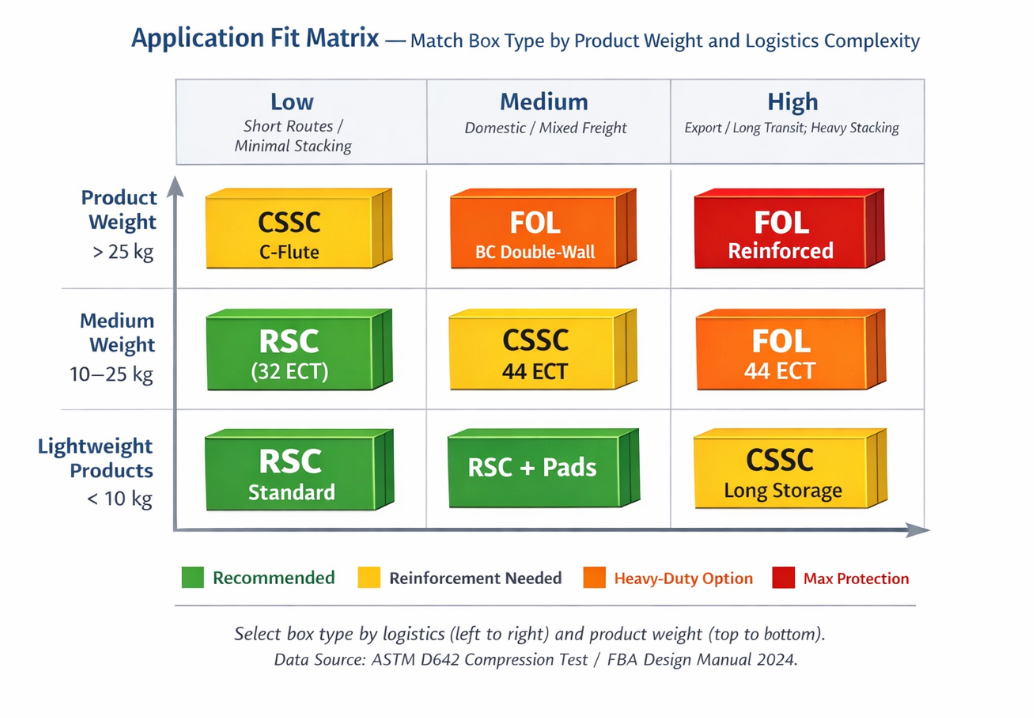
Each cell suggests the most material-efficient box design for reliable stacking and transit protection.
Data reference: ASTM D642 Compression Test / FBA Design Manual 2024.
Customizing Slotted Boxes with Witpax
You can tailor slotted boxes with Witpax to match your product, budget, and shipping needs. The team supports a bunch of packaging solutions—from basic shipping cartons to branded retail boxes.
You get to pick the structure, strength, and layout that work for your use case. If you care about minimizing wasted space or boosting protection, custom sizes make a difference.
Add dividers or partitions to keep items separated during transit. These inserts come in handy for things like electronics, food kits, or multi-item orders.
Even a pizza box layout fits this system. You can tweak venting and fold styles for heat and handling, depending on what you’re shipping.
Witpax gives you a few printing options, so you control the look:
- Flexo printing for clean, cost‑effective branding
- Offset printing for high-detail graphics
- Digital printing for short runs and fast updates
You can also pick coatings and finishes to match your brand vibe:
- UV coating for added durability
- Matte finish for a smooth, muted look
- Soft touch for a refined feel
These options let your box protect the product and present it cleanly. Witpax designs boxes for storage, shipping, and display—without making things complicated.
Request a custom slotted box quote if you want to build a box that fits your exact needs. If customization matters, Witpax covers the bases.
FAQ
What is the most common slotted box type?
The Regular Slotted Container (RSC) shows up everywhere—shipping, storage, e‑commerce, you name it. All the flaps are the same length, and the outer flaps meet right in the center.
This design makes it easy to seal with tape or staples. If you just need a reliable, straightforward box, RSC is usually the default choice.
What’s the difference between RSC and FOL?
An RSC’s flaps just meet at the center—no overlap. A Full Overlap (FOL) box, on the other hand, has outer flaps that completely overlap each other.
Go with an RSC for standard shipping and lower cost. If you need extra strength, better stacking, or more protection for heavy or fragile stuff, FOL is the safer bet.
So, if durability matters, FOL usually wins out.
Are slotted boxes eco-friendly?
Yes, slotted boxes are eco-friendly. Most slotted boxes use corrugated cardboard. You can toss them in the recycling bin when you’re done.
Plenty of manufacturers use recycled fiber, too. Since they ship flat and rely on simple materials, you end up with less waste.
Reusing a box also stretches its lifespan, which helps a bit more.
Can I print custom designs on slotted boxes?
Sure, you can print logos, text, or simple graphics right on slotted boxes. Flexographic printing handles branding and handling marks pretty well.
Adding barcodes or instructions is no problem if you need to support shipping or inventory. Customization is straightforward here.