A folding carton is a lightweight, durable, and versatile type of packaging made from paperboard, designed to be stored and shipped flat and easily folded into a box shape. Folding cartons are widely across industries like food and beverages, electronics, cosmetics, and pharmaceuticals. Businesses choose folding cartons because they enhance product protection, strengthen brand presence, lower environmental impact, and reduce packaging costs.
Six common types of folding cartons used in packaging include straight tuck end (STE), reverse tuck end (RTE), auto-lock bottom box, snap-lock bottom box, two-piece box, and sleeve packaging.
Brands can customize folding cartons through five key steps: designing brand elements, choosing suitable materials, selecting surface finishes, adding accessories like inserts or windows, and collaborating with a packaging manufacturer to ensure quality and functionality.
How is a folding carton made?
A folding carton starts as flat sheets of paperboard. First, we print on these sheets. Then, we cut them into shape with a die-cutter. Finally, we fold and glue them into a box using a folder-gluer machine. Sometimes, a protective layer is added before cutting to make the surface shiny, waterproof, or more durable. After gluing, the boxes are shipped flat and folded into shape later when they are filled with products.
What are the fundamental parts of a folding carton?
A folding carton is a paperboard package made of three key parts: panels, flaps, and tabs.
- Panels
Panels are the main flat sides of the carton. Most cartons have four panels: front, back, and two sides. They give the box its shape and are usually where the printing, like logos, product details, and images goes.
- Flaps (Top and Bottom)
Flaps are the pieces that close the top and bottom of the box. There are usually two flaps on the top and two on the bottom. They fold in and are either glued or tucked to keep the box closed.
- Tabs
Tabs are small extensions that help lock the flaps in place. Some tabs slide into slots to keep the box closed without glue. Others are used during gluing to connect different parts of the carton.
6 common types of folding cartons
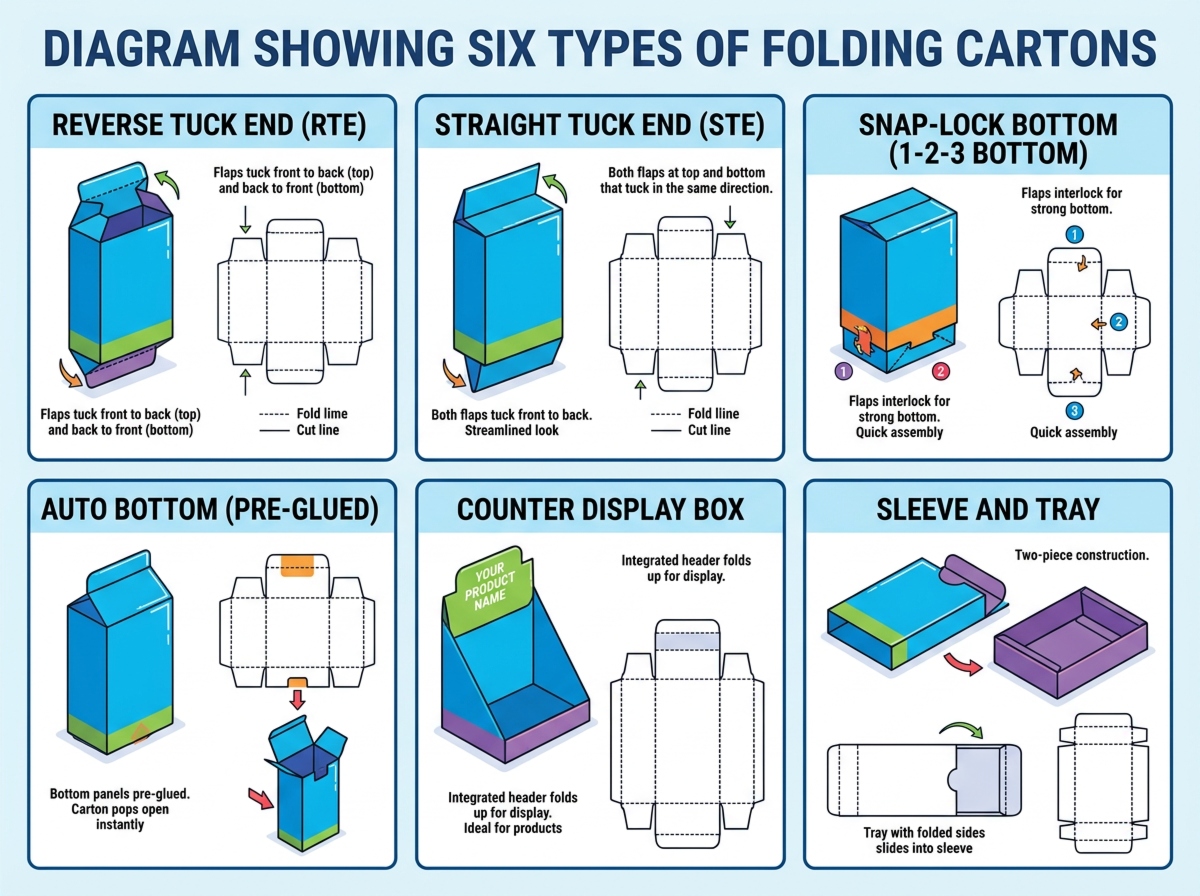
Folding cartons are classified by their structural design or closure style into 6 main types:
- Straight Tuck End (STE)
- Reverse Tuck End (RTE)
- Auto-lock Bottom Box
- Snap-lock Bottom Box
- Two-Piece box
- Sleeve packaging
- Straight Tuck End (STE)
In a straight tuck end carton, both top and bottom flaps tuck in the same direction, usually to the back. This gives a neat front and smooth edges, which is great for clear printing.
- Reverse Tuck End (RTE)
A reverse tuck end carton has the top flap tucking to the back and the bottom flap tucking to the front, so the flaps fold in opposite directions.
- Auto-lock Bottom Box
The bottom has pre-glued flaps that lock together when the box is opened. This makes the box strong and saves time during assembly. It is great for heavier products that need extra support, like electronics, glass bottles, and bulk food items.
- Snap-lock Bottom Box
The bottom panels are folded and locked by hand to make a sturdy base. This design is good for products that need a strong bottom but don’t need fast packing, like bakery items, small electronics, or home goods.
- Two-Piece box
Two-piece boxes, also called telescoping cartons, consist of two separate parts: a tray and a lid. The lid fits over the tray to fully enclose the product. This design offers strong protection and makes it easy to open and close the box without damaging it.
- Sleeve packaging
Sleeve cartons, also known as sleeve boxes or belly band packaging, are simple paperboard or card sleeves that wrap around a product, tray, or inner box. They don’t have top or bottom flaps; instead, the sleeve wraps around the product to add branding, extra protection, or a more premium look.
What are folding cartons used for?
Folding cartons are very popular for packaging. They are widely used for food and beverages, electronic devices, cosmetics, and pharmaceuticals. Folding cartons are widely used because they are cost-effective and customizable.
Used for Food & Beverage
Folding cartons are widely used for packing snacks, cereals, frozen foods, and beverages because they are strong and easy to handle. They provide plenty of space to show important details like nutrition facts, ingredients, how to use the product, and the expiry date.
Some cartons include inserts to hold fragile items in place, and tamper-proof seals to protect the product. In 2021, the food and beverage industry used more than half of all folding cartons, according to Allied Market Research. To make sure they are safe, food-grade folding cartons meet rules like ISO 22000 for food safety, BRCGS for packaging safety, and FDA and EFSA guidelines for food contact materials.
Used for electronic devices
Folding cartons are often used to pack small items like smartphones, headphones, and computer accessories. They protect fragile devices during shipping and handling. Some cartons include anti-static or ESD protection to prevent damage from electrical discharge.
Many folding cartons also have custom inserts to keep parts in place and show the product neatly. They include space for key details, such as instructions, certifications, and warranty info. In this industry, folding cartons meet key standards like ISO 9001, RoHS, CE, and UL to ensure safety and quality. They also support the environment with certifications like FSC and PEFC.
Used for cosmetics
Folding cartons are widely used in the cosmetics industry to package skincare products, perfumes, makeup, and personal care items. Their custom designs and finishes help brands look unique and attract buyers. These cartons provide space for key details like ingredients, instructions, and safety warnings. They can also include inserts to keep delicate items safe.
To ensure quality and safety, folding cartons follow standards like ISO 9001, GMP, and REACH. Many makers also use FSC or PEFC-certified paperboard to protect the environment.
Used for pharmaceuticals
In the pharmaceutical industry, folding cartons are used to pack tablets, capsules, syrups, and medical devices. They protect products, show if the package has been opened, and provide clear branding. These cartons show key details like dosage instructions, safety warnings, and expiry dates. Inserts help hold bottles or blister packs securely.
To ensure safety and compliance, pharmaceutical folding cartons follow standards like GMP, ISO 15378, FDA, EMA, and BRCGS. Many also use FSC or PEFC-certified materials to support sustainability.
What are the benefits of folding cartons for brands?
The benefits of folding cartons for brands are listed as below.
- Enhances product protection
- Elevates the brand’s presence
- Reduces environmental impact
- Reduces packaging costs
Enhances product protection
Folding cartons are a great way to protect products because they are strong and well-designed. They are made of sturdy paperboard. This material protects items like cosmetics, medicine bottles, and small electronics from pressure and impact. The way folding cartons are built, with tight folds, flaps, and locking tabs, helps hold products firmly inside so they do not move around.
Folding cartons act as a second layer of protection. They do not touch the product directly but cover the main package, such as a bottle, tube, or vial. This extra layer absorbs shocks and pressure, so the primary container is less likely to break or leak.
Folding cartons can also include custom inserts like molded pulp trays or cardboard dividers. These inserts hold items like jars, bottles, or electronics tightly in place.
Elevates the brand’s presence
Brand presence is how easily customers recognize and remember a brand, thanks to packaging design. Folding cartons are key for boosting brand visibility because they offer a customizable space for eye-catching designs and strong messages.
A 2023 study by Maurel Sara Hasibuan and Shimaditya Nuraeni in Behavioral Sciences found that cosmetic packaging attributes like color tone, material, closure type, and graphics strongly influence Gen Z customers’ purchase intentions. Good packaging raises brand credibility, desirability, and trust. This, in turn, makes people more likely to buy.
As secondary packaging, folding cartons shape how the product is perceived at first glance. Their printable surfaces allow for high-resolution graphics, detailed illustrations, and bold typography. They also come with various textures and finishes. Options like soft-touch coatings, embossing, foil stamping, and spot UV create a multisensory experience.
Reduces environmental impact
Folding cartons are a good choice for the environment. They are made from paperboard that can be recycled easily. Folding cartons cut down waste in landfills. They also support a circular economy by reusing materials.
These cartons are made from wood pulp, which is a rapidly renewable natural resource. After folding cartons are used, they can be collected and turned into new paper products. This process helps save forests and encourages responsible use of natural resources.
Reduces packaging costs
Folding cartons help reduce packaging cost because they lower shipping weight, enhance storage efficiency and are compatible with automation. Folding cartons are lightweight and can be packed flat. Because they fold flat, they take up less space in storage, which helps reduce warehouse and delivery costs. They also work well with automated packing machines, so businesses can pack products faster and with fewer workers.
A 2019 McKinsey study on “skinny design” found that changing packaging from rigid formats to lightweight, efficient paperboard cartons can save 5% to 35% in packaging and logistics costs. Many companies see savings of about 25% due to lower material, weight, and transport expenses.
Startups and established companies can benefit from folding cartons. They help cut costs while still providing quality packaging. This type of carton protects products and promotes them effectively.
How to customize folding cartons for your brand?
To customize folding cartons for your brand, follow the five steps:
- Design Brand Elements
- Choose materials for folding cartons.
- Select Finishes for Folding Cartons
- Add accessories for the folding carton.
- Collaborate with a packaging manufacturer.
Customizing folding cartons is important because it helps your product stand out, attracts customers, and builds brand recognition. Unique shapes and eye-catching prints make packaging stand out.
- Design Brand Elements
Start by adding your logo in a visible spot to build recognition. Use your brand’s colors and fonts to keep the design aligned with your other products and marketing materials. Consistent use of these elements helps customers remember your brand and trust your products.
- Choose materials for folding cartons.
Choosing the right material is key to protecting your product and showing your brand’s quality. Pick your board based on the product’s weight, storage conditions, and desired look. Many boards are multi-ply (made of layers), which makes them stronger and better for high-quality printing.
| Material | Features | Best For |
| SBS (Solid Bleached Board) | White, smooth, strong, usually multi-ply | Premium cosmetics, luxury packaging |
| FBB (Folding Box Board) | Stiff, food-safe, multi-ply, always multi-ply | Food, pharmaceuticals, cosmetics |
| CUK (Coated Unbleached Kraft) | Durable, natural brown look, multi-ply | Beverages, frozen or heavy food |
| CRB (Coated Recycled Board) | Cost-effective, eco-friendly, multi-ply | Everyday retail items |
Always check that the board is FSC or PEFC certified to show customers your commitment to responsible sourcing and sustainability.
- Select Finishes for Folding Cartons
Finishes add the final touch that makes your folding carton stand out and align with your brand’s image. Popular finishes include Foil Stamping, Embossing or Debossing, and Spot UV.
Choose a finish that matches your brand personality. For example, matte for understated elegance or foil stamping for a high-end look. Also, combine finishes like matte coating with spot UV to create contrast and draw attention to your logo or key details.
- Add accessories for the folding carton.
Add accessories like inserts and window cutouts. They can boost your folding carton’s look and enhance the user experience.
Inserts like foam or cardboard trays securely hold fragile or multiple items inside the box, keeping them safe and organized and also making your product more luxurious and professional.
Window cutouts are transparent openings on the carton’s surface, usually covered with clear film. They allow customers to see the product inside, boosting trust and visual appeal.
- Collaborate with a packaging manufacturer.
Find the right packaging partner to ensure your folding cartons are made to your exact needs. Look for manufacturers with experience, quality control, and good communication.
Tip: Always ask for a prototype before full production. This helps you check the design, materials, and fit, saving time and costs later.
FAQ
What information do I need to provide to get a quote for custom folding cartons (e.g., dimensions, artwork files)?
To get an accurate quote, you should provide:
- Dimensions (length, width, height) of the carton.
- Quantity required
- Artwork files (logo, design, and any branding elements)
- Material preferences or special finishes
- Any special requirements, like inserts, windows, or tamper-evident features.
Giving clear details helps the manufacturer calculate costs accurately. This way, they can suggest the best options for you.
What is the typical cost range for custom folding cartons?
The cost of custom folding cartons varies widely depending on size, material, quantity, finishes, and complexity. Prices also depend on order volume (larger orders usually lower unit costs) and any custom finishes or accessories.
| Size | Estimated Cost/Unit | Best For |
| Small | $0.25 – $1.50 | Small products, budget-friendly solutions |
| Medium | $1.50 – $3.00 | Cosmetics, pharmaceuticals, mid-sized goods |
| Large | $3.00 – $6.00+ | Electronics, luxury packaging, large products |
What is the difference between folding cartons and corrugated boxes?
Folding cartons and corrugated boxes are different. They vary in materials, structure, protection, and common uses.
- Material: Folding cartons use one layer of paperboard. In contrast, corrugated boxes have many layers of fiberboard.
- Structure: Folding cartons are light, flexible, and can easily take on various shapes. In contrast, corrugated boxes are thicker, sturdy, and offer cushioning.
- Protection: Folding cartons work well for light to medium-weight items like cosmetics, food, and medicine. Corrugated boxes are designed for heavy items and shipping protection.
- Applications: Folding cartons are often used for retail packaging. Corrugated boxes are popular for shipping, bulk packaging, and e-commerce deliveries.
What is the difference between a folding carton and rigid boxes?
Folding cartons and rigid boxes mainly differ in their construction, material strength, and how they are shipped and used.
- Material & Structure: Folding cartons are made from a single layer of paperboard. Rigid boxes are made from thick chipboard.
- Assembly: Folding cartons are shipped flat to save space and shipping costs. Rigid boxes come pre-made and cannot be folded flat.
- Protection: Folding cartons give basic to moderate protection. Rigid boxes provide much better strength and protection for valuable items.
Applications: Folding cartons are often used for food packaging, cosmetics, medicines, and light retail items. Rigid boxes are used for luxury goods, high-end electronics, and jewelry.