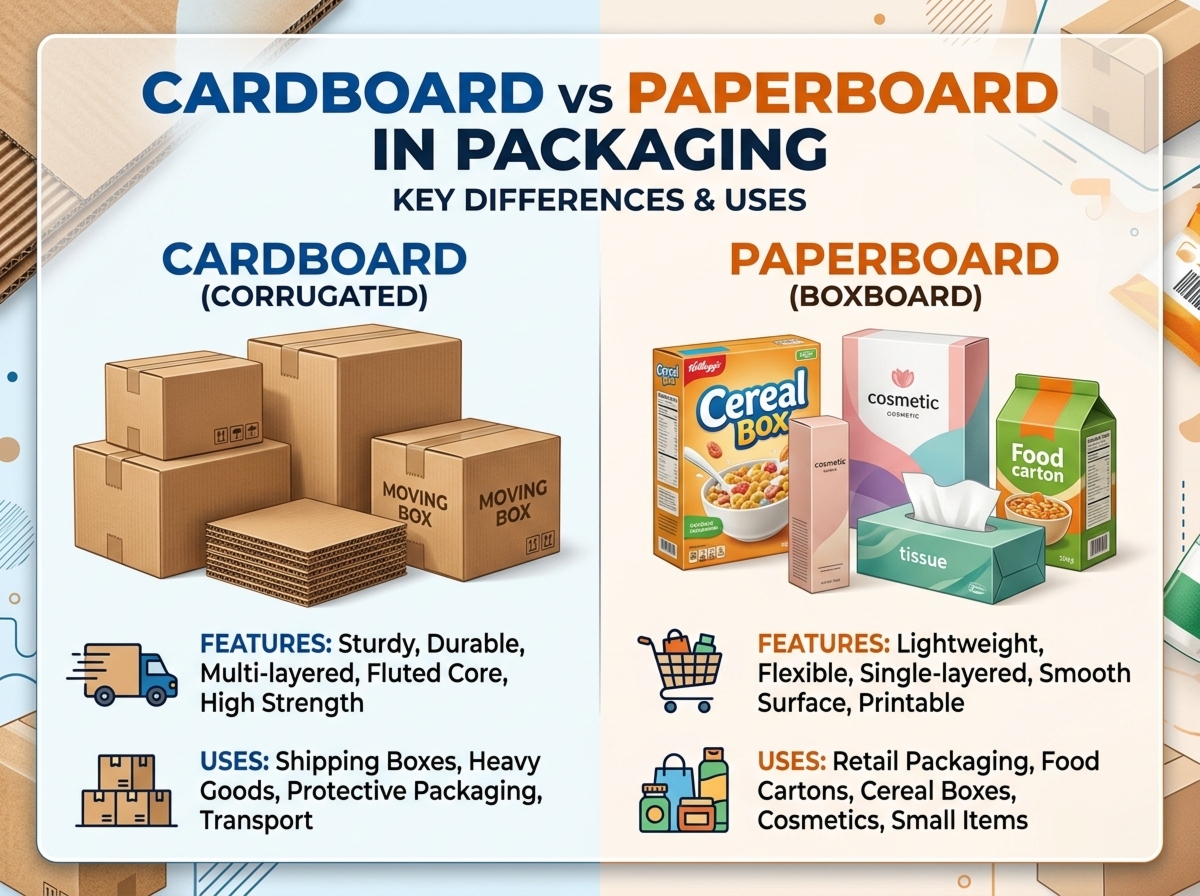
Paperboard and cardboard are often used interchangeably, but in packaging they refer to two different materials with distinct structural properties. This confusion usually comes from everyday language, not from how packaging materials actually perform in production, printing, and distribution.
In packaging, the difference between paperboard and cardboard matters because each material is engineered for a specific purpose. Paperboard is designed for controlled thickness and surface quality, while cardboard—most commonly corrugated cardboard—is built for strength and protection.
This article compares paperboard vs cardboard at the material level, explaining how their structure, performance, and physical characteristics influence packaging decisions and real-world use.
What Is a Paperboard?
Paperboard is a single-layer, paper-based board you’ll spot in all kinds of packaging. It’s what you get in most retail boxes, and manufacturers make it from paper fibers—sometimes recycled, sometimes straight from the source.
Its thickness goes by caliper, measured in points (one point is a thousandth of an inch). Thicker means sturdier, but even the thick stuff feels lighter than cardboard.
Unlike corrugated stuff, paperboard gets its rigidity from how tightly they press the fibers. You end up with a dense sheet that holds its shape, folds neatly, and takes printing like a champ.
Common types of paperboard:
- SBS (Solid Bleached Sulfate): Bright white, made from virgin fibers. Used for food, cosmetics, and health products.
- FBB (Folding Boxboard): Layered core, coated surfaces. You’ll see it in dry and frozen food boxes.
- CCNB / CUK: Recycled chipboard with a coated top. Think cereal, toys, and household goods.
SBS delivers the smoothest surface and best print results. FBB strikes a balance between strength and cost. CCNB leans into recycled content and works for budget packaging.
Paperboard’s smooth surface really helps with print quality. You get crisp colors and sharp text, plus it folds and creases cleanly for sharp box edges.
It’s also lightweight but strong enough for most retail uses. Some folks lump it in with fiberboard, but it’s not the same as those thicker, more structural boards.
What Is a Cardboard? (Corrugated Cardboard)
Here, when I say cardboard, I mean corrugated board—the stuff you see in shipping boxes and moving boxes everywhere.
Corrugated cardboard sandwiches a wavy fluted layer between two flat linerboards. That fluted core gives it surprising strength without piling on the weight. It’s what people call corrugated fiberboard.
The flutes spread out force, so when something hits the box, the wavy layer flexes and absorbs the shock. That’s why it’s so good at resisting compression and protecting your stuff.
Types of corrugated cardboard:
- Single-wall: One fluted layer between two linerboards.
- Double-wall: Two fluted layers, three linerboards—built for heavy loads and rough handling.
Flute size matters too:
- A: Thick cushioning for fragile items.
- B: Strong stacking for packaging.
- C: Balanced for shipping.
- E: Thinner, good for retail boxes with better print.
- F: Very thin, for small, rigid packs.
What’s it like to use? You get high compression resistance, solid impact absorption, and it holds up over time. Corrugated layers just work for transport and storage—no wonder they’re everywhere.
Paperboard Vs Cardboard: Material Differences That Matter
Paperboard and cardboard aren’t built the same. They differ in structure, strength, print quality, cost, and even how green they are. These differences really show up when you’re picking packaging for a specific job.
Structure And Thickness
Paperboard is a single, solid sheet of pressed fibers. You’ll find it in folding cartons and lightweight retail boxes, measured in points or grams per square meter.
Cardboard, on the other hand, is almost always corrugated. It’s got that wavy middle layer sandwiched between flat sheets, which adds air space and stiffness.
You pick structure based on how much support and shape you need. Simple as that.
Strength And Protection
Cardboard wins for strength and durability. The corrugated core lets it stack high and shrug off bumps during shipping. It’s the go-to for protective packaging and bulk transport.
Paperboard handles light to moderate protection. It’s fine for short trips or shelf display—just don’t expect it to survive a warehouse tumble.
- Cardboard resists crushing and bending.
- Paperboard keeps its form with lighter loads.
- Corrugated walls do a better job guarding edges and corners.
If you’re shipping fragile or heavy stuff, cardboard’s a safer bet. For smaller consumer goods, paperboard usually does the trick.
Print Quality And Surface Finish
Paperboard shines when you want top-notch printing. Its smooth surface takes ink evenly, so your colors pop and the details stay sharp. You can add coatings, lamination, or even foil for that fancy retail vibe.
Cardboard is more about function. Sure, you can print on it, but the texture limits detail. Most brands keep graphics simple or just slap on a label.
- Paperboard: offset or digital printing, gloss or matte finishes.
- Cardboard: flexographic printing, basic coatings.
If shelf appeal is your thing, paperboard gives you more control over the look.
Weight And Cost Considerations
Paperboard is lighter than cardboard. That saves on shipping for small packages and makes storage easier.
Cardboard costs more per box because of the extra material and work involved. But if you need strength, it’s usually worth it.
- Material thickness and grade
- Shipping weight and volume
- Risk of damage in transit
It’s all about balance—don’t overbuild and waste money, but don’t skimp and risk product loss either.
Sustainability And Recyclability
Both come from wood fibers and fit into most recycling programs. Manufacturers use a lot of recycled content, and you can recycle them again after use.
Paperboard usually uses less material, so it’s a bit lighter on resources. Cardboard makes up for its bulk by being reused a lot, especially for shipping.
- Both recycle easily in curbside bins.
- Water-based inks help recyclability.
- Too much lamination can mess with recycling, so watch out for that.
You can boost sustainability by picking the right grade, skipping heavy coatings, and designing for easy reuse or recycling.
Paperboard Vs Cardboard In Packaging Applications
Your choice really depends on how you sell, ship, and protect your products. Each material has its strengths for different loads, printing needs, and handling.
Paperboard In Retail And Folding Carton Packaging
Paperboard shines when looks matter and the package stays light. It’s perfect for folding cartons—the stuff bends neatly, holds sharp creases, and prints with a ton of detail. That’s why you see it everywhere in retail.
Think cereal boxes, food and cosmetic packaging, beverage cartons, and premium boxes. Even frozen food uses it, with special coatings to block moisture.
- Smooth for branding and graphics
- Lightweight for shelves
- Crisp folds for cartons and rigid boxes
If you try to use paperboard for shipping or bulky stuff, it just doesn’t hold up. The strength isn’t there for stacking or long hauls.
Cardboard In Shipping And Corrugated Box Packaging
Cardboard—really, corrugated packaging—is your workhorse for strength and protection. Those layered sheets with a fluted core soak up impacts and let you stack boxes high.
You’ll find it in shipping boxes, e-commerce packaging, heavy-duty cartons, and bulk packaging. It’s made for rough handling and heavy loads.
- High compression strength for pallets
- Cushioning for long trips
- Size flexibility—almost any box style
Trying to use corrugated cardboard for folding cartons or luxury packaging? It just doesn’t look as sharp, and the cost goes up. It’s a protector, not a show-off.
E-commerce Packaging: Where Both Materials Work Together
E-commerce packaging often combines both materials into a single packaging system. A common setup includes a corrugated outer box for protection and a paperboard inner carton for presentation.
This layered approach reflects how packaging decisions are made in practice. Each material plays a specific role based on what the finished package needs to do at each stage—from shipping to unboxing.
In these cases, the question isn’t paperboard or cardboard. It’s how each material contributes to the overall packaging experience.
How To Choose Between Paperboard And Cardboard
You’ve got to match the material to your product. Start with weight, size, and how much protection you need. Light, low-risk items? Paperboard’s probably fine. Heavy or fragile? Go with cardboard for the extra strength.
Think about brand presentation and design too. Paperboard lets you get creative—sharp prints, clean folds, custom shapes. Great for retail and custom packaging. Cardboard’s about function and protection, not fancy finishes.
- Product weight: Paperboard for light stuff, cardboard for heavy.
- Protection: Cardboard wins for high protection.
- Print quality: Paperboard, hands down.
- Shipping: Cardboard is the standard.
- Retail display: Paperboard looks better on shelves.
Don’t forget sustainability. Both materials use recycled fibers, and most options are recyclable if you source them right. Ask suppliers about recycled content and check local recycling rules, just to be sure.
Budget matters too. Paperboard usually costs less for small runs or detailed designs. Cardboard might be pricier, but it can save money by preventing shipping damage and returns.
In the end, pick what fits your real use case and sustainability goals. Protect your products, support your brand, and give customers what they expect—just don’t overthink it.
FAQ
Is paperboard stronger than cardboard?
Nope. Cardboard, which usually means corrugated board, has layers that boost its strength. You’ll get better stacking and impact resistance with corrugated cardboard—no contest there.
Is cardboard always corrugated?
Not really. People toss around “cardboard” for all sorts of stuff. In the packaging world, “cardboard” is mostly corrugated, while paperboard is that single, flat sheet you see on cereal boxes.
Can paperboard be used for shipping?
Yeah, for lighter things. You can ship small products with paperboard if you add inserts, dividers, or pack everything in a sturdy corrugated box for backup.
Which material is more sustainable?
Both can be pretty sustainable. It all comes down to where the fibers come from, how much recycled content is in there, and what coatings are used.
You’ll make the best choice by thinking about how much strength you need, how far you’re shipping, and what your local recycling rules allow. It’s not always obvious—sometimes you just have to weigh the options and pick what feels right.