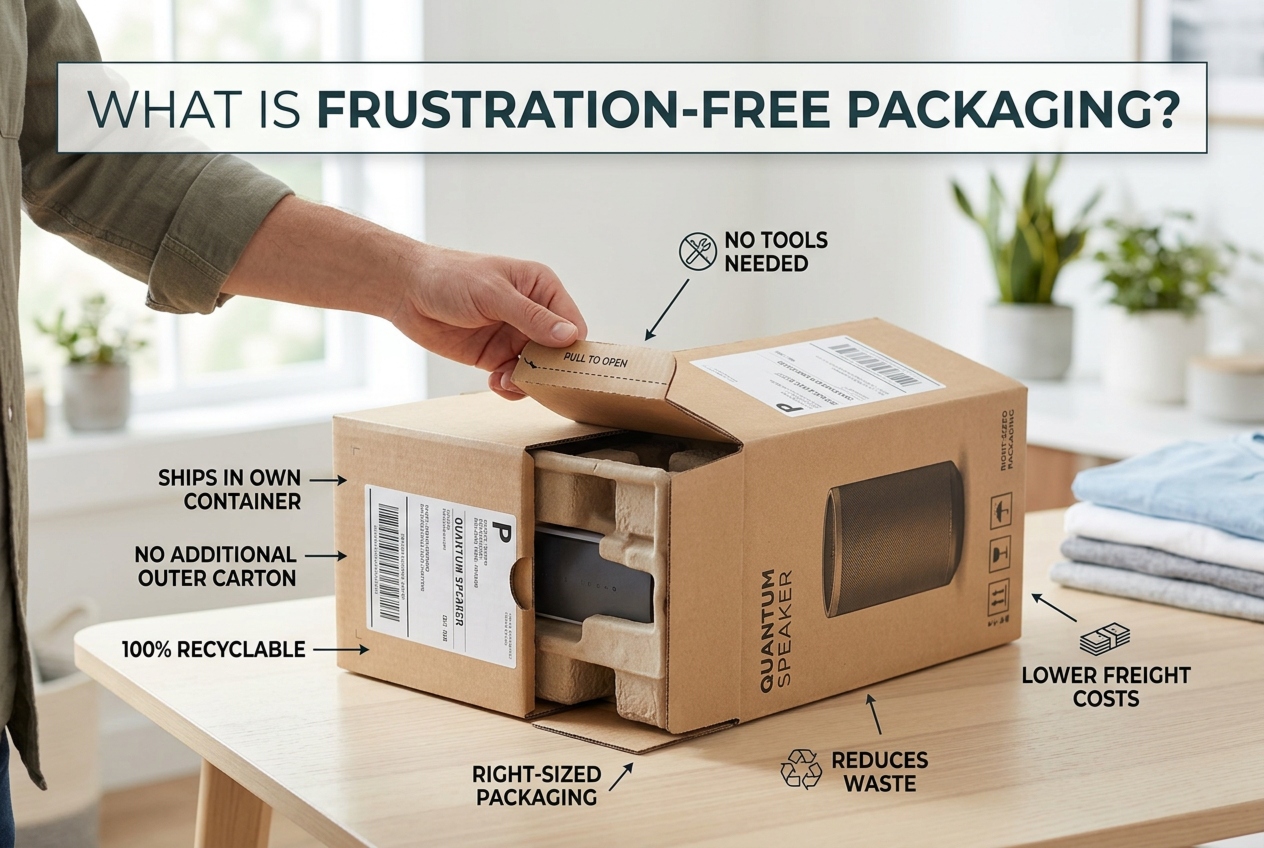
Frustration-free packaging is a method of packing products in recyclable, right-sized boxes that open without tools and ship without an additional outer carton. Amazon introduced the concept in 2008 to cut waste, lower freight costs, and remove the struggle consumers face when opening online orders. The approach has since grown into a widely adopted standard across e-commerce.
The logic is straightforward. A product that sells online does not need shelf appeal. It needs protection during transit and an easy opening at the doorstep. Frustration-free packaging delivers both. One corrugated box replaces the retail box, the shipping carton, and the filler material. The customer pulls a tab, lifts the product out, and drops the box in the recycling bin.
This article covers the origin, requirements, certification process, cost structure, and material choices behind frustration-free packaging. Every section is written from the perspective of WitPax, a corrugated box manufacturer that helps brands design and produce packaging to these standards.
Why Was Frustration-Free Packaging Created?
Amazon created frustration-free packaging in 2008 to solve wrap rage—the anger and physical difficulty people experience when a package is hard to open. Customers had been reporting cuts from plastic clamshells, wasted time untangling wire ties, and damaged products from forced openings.
Traditional retail packaging was designed for store shelves. Plastic blisters displayed the product. Wire ties held accessories in position. Heat-sealed shells prevented shoplifting. These features served their purpose in a physical store where the customer could see and touch the package before buying.
E-commerce changed the equation. Online shoppers make decisions based on product photos, descriptions, and reviews. They never see the packaging until it arrives. All those retail features—the clear windows, the glossy printing, the anti-theft seals—become obstacles instead of advantages. The customer at home does not want shelf appeal. They want to reach their product quickly and safely.
Amazon asked a practical question: what if the product’s own box was strong enough to ship directly, without a second carton? What if it opened with a pull instead of a cut? What if it was made entirely from recyclable paper instead of mixed plastics? The answers became the rules of frustration-free packaging.
WitPax sees this shift in every sales conversation. Brands that once ordered complex retail displays now ask for clean corrugated mailers that protect the product, open in seconds, and recycle curbside. The market is moving, and frustration-free design is where it’s going.
What Is the Difference Between Frustration-Free Packaging and Standard Packaging?
Frustration-free packaging uses only recyclable materials, opens without tools, and doubles as its own shipping container. Standard packaging uses mixed materials such as plastic and foam, often requires cutting tools to access, and normally needs a separate outer carton for shipping.
Standard packaging was designed for retail. Bright colors attract the eye. Clear windows show the product. Thick plastic shells prevent theft. These features help a product compete on a store shelf. But they create cost, waste, and frustration in the e-commerce supply chain.
Frustration-free packaging was designed for delivery. The product box is the shipping box. Tear strips replace tape. Corrugated inserts replace foam peanuts. The customer opens the box by hand in under two minutes, uses the product, and recycles the cardboard. No scissors. No layers of plastic. No pile of non-recyclable waste.
The table below compares both approaches across the dimensions that matter most to e-commerce sellers.
| Feature | Frustration-Free | Standard |
| Opening method | Pull tab or tear strip; no tools; under 120 seconds | Scissors, box cutter, or brute force often needed |
| Materials | 100 % curbside recyclable — corrugated cardboard, molded pulp, paper cushion | Mixed — plastic clamshells, foam, wire ties, shrink wrap, non-recyclable fillers |
| Waste volume | Low; single box replaces retail box + shipping box + filler | High; multiple layers, most not recyclable together |
| Shipping cost | Lower — right-sized, lighter, more units per pallet | Higher — oversized, heavier, wasted dimensional weight |
| Transit protection | ISTA 6 lab-tested; snug fit limits movement damage | Varies; loose fit allows shifting and breakage |
| Branding | Minimal exterior; inside printing available | Full-color graphics, windows, shelf presence |
| Best channel | E-commerce, DTC, Amazon FBA | Brick-and-mortar retail, luxury, gifting |
The right choice depends on your sales channel. Products on retail shelves still need standard packaging that catches the eye. Products shipped from a warehouse to a doorstep perform better in frustration-free packaging because cost is lower, damage rates drop, and customer reviews improve.
Many brands sell through both channels. WitPax manufactures both formats from the same facility, so a single supplier can cover Amazon FBA, DTC web orders, and wholesale retail accounts.
How Does Amazon’s Packaging Certification Program Work?
Amazon’s program, now officially called Ships in Product Packaging (SIPP), certifies that a seller’s box can ship directly to the customer without an Amazon overbox. Sellers enroll ASINs through Seller Central, test their packaging against ISTA 6 standards, and receive a certification tier that unlocks benefits and removes chargebacks.
The economics are simple. Every time Amazon places a product into one of its brown shipping boxes, it spends money on that box, on filler material, and on the labor to pack it. When the product’s own packaging is strong enough to ship alone, Amazon skips that step. The product moves directly from the warehouse shelf to the delivery truck.
To earn that trust, Amazon requires proof. The seller submits packaging photos and dimensions, then tests the package against a standardized transit simulation called ISTA 6. If the product survives drops and vibrations without damage, and the box meets Amazon’s material and design rules, the ASIN receives certification.
Amazon enforces compliance with a $1.99 per-unit chargeback applied to non-certified ASINs that exceed the size threshold (18″ × 14″ × 8″ or 20 lbs). The chargeback makes it financially painful to ignore the program. On the reward side, Tier 1 certified products gain eligibility for the Frustration-Free Packaging storefront and Amazon Vine.
What Are the Three Certification Tiers?
Amazon’s SIPP program has three tiers. Tier 1, Frustration-Free Packaging (FFP), is the highest. Tier 2, Ships in Product Packaging (SIPP, formerly SIOC), is the mid-level. Tier 3, Prep-Free Packaging (PFP), is the baseline. Each tier adds rules on top of the one below.
| Requirement | Tier 1 – FFP | Tier 2 – SIPP | Tier 3 – PFP |
| Ships without overbox | Yes | Yes | No |
| Easy open (≤ 120 s) | Required | Not required | Not required |
| 100 % recyclable | Required | Not required | Not required |
| ISTA 6 transit test | Required (SIOC) | Required (SIOC) | Required (overbox) |
| $1.99 chargeback risk | None | None | Yes, if uncertified |
Tier 1 – Frustration-Free Packaging (FFP). The package is a six-sided corrugated rectangle. All materials are 100 % curbside recyclable. The customer opens the box and removes everything inside within 120 seconds, without tools. No plastic shells, wire ties, foam peanuts, or blister packs. The box passes an ISTA 6 SIOC transit test. Products certified at this level receive marketing placement and Vine eligibility.
Tier 2 – Ships in Product Packaging (SIPP). The product ships in its own packaging without an Amazon overbox. The box passes the same ISTA 6 SIOC test as Tier 1, but there are no strict rules on recyclability or opening speed. This tier suits brands that have made the structural switch but have not yet eliminated all non-recyclable components.
Tier 3 – Prep-Free Packaging (PFP). The product arrives at Amazon’s warehouse ready to be placed inside an Amazon overbox without extra preparation by Amazon workers. The packaging passes an ISTA 6 overbox test. Amazon still provides the outer shipping carton.
Any ASIN larger than 18″ × 14″ × 8″ or heavier than 20 lbs must achieve Tier 2 or higher. Failure to certify triggers a $1.99 chargeback per unit sold.
WitPax engineers corrugated structures that target Tier 1 from the start. We match flute profile, board grade, and closure mechanism to each product so the design passes testing on the first submission.
What Are the Exact Design Requirements for FFP?
FFP packaging must be a six-sided rectangular corrugated box, made from 100 % curbside recyclable materials, that opens in under 120 seconds without tools, fits the product within 50 mm of clearance on each side, and passes an ISTA 6 SIOC transit test.
Shape. The box must be rectangular with six flat faces. L-shaped boxes, tubes, bags, and pouches do not qualify. Minimum product dimensions for eligibility: 6″ × 4″ × 0.375″. Maximum weight: 50 lbs.
Materials. Every component must be curbside recyclable. Corrugated cardboard, paperboard, molded pulp, kraft paper cushioning, and paper tape qualify. Polystyrene foam, bubble wrap, plastic trays, and packaging peanuts do not. Small HDPE or LDPE poly bags are allowed only for loose parts containment or dust protection.
Opening speed. The customer removes all contents—product, accessories, manuals—within 120 seconds. This means the box must open with a tear strip, peel-and-seal tab, or simple tuck flap. Heavy tape, nested inner boxes, and glued seals that require cutting all slow the process past the limit.
Right-sizing. No more than 50 mm of space between the product and the inner wall of the box. If void filler is needed, the box is too large. A properly sized box eliminates wasted material, prevents product shifting, and reduces dimensional weight.
Prohibited features. No windows. No cutouts. No protruding hang tabs. No staples as a sealing method (permitted only on manufacturer glue joints). Hand holes for carrying may not exceed 3.5″ × 1.0″.
WitPax builds these specifications into every structural prototype before the client spends money on testing. Compliance is engineered in, not patched on afterward.
What Is ISTA 6 Testing and How Does a Package Pass?
ISTA 6 is a transit test protocol created by the International Safe Transit Association for Amazon’s distribution network. It subjects the package to free-fall drops, vibration, and impact to simulate real shipping conditions. Passing the test proves the product will arrive undamaged without an overbox.
The test sequence depends on weight and size. Type A covers products under 50 lbs and under 165″ girth. Type B covers 50–100 lbs. Types C through F cover oversized and heavy freight. Each type has a prescribed order of drop heights, drop orientations (face, edge, corner), and vibration durations.
Two testing paths exist. Non-fragile products under 50 lbs qualify for self-testing, where the seller follows Amazon’s Vendor Drop Test procedure at their own facility. The seller drops the box from a measured height onto each face, edge, and corner, then inspects for product damage. Fragile products, items over 50 lbs, and products containing glass or liquid must be tested at an ISTA-certified lab. Amazon’s APASS network (Amazon Packaging Support and Supplier Network) is a curated group of labs trained specifically in ISTA 6 procedures.
A common error is sending packaging to a lab before verifying it meets the design requirements. If the box contains non-recyclable materials, takes too long to open, or has prohibited features like windows, it will fail the review regardless of transit test results. Fix the design first. Test second.
WitPax selects flute type and board grade during the design phase based on the product’s weight, fragility, and center-of-gravity profile. This front-loaded engineering means our clients’ packages routinely pass ISTA 6 on the first attempt, avoiding the cost of redesign and retest.
Why Does Frustration-Free Packaging Cost Less Than Standard Packaging?
FFP costs less because it uses fewer materials, produces smaller boxes, lowers shipping weight, speeds up packing labor, and reduces product damage during transit. Each saving compounds across high-volume fulfillment.
Fewer materials. Standard packaging layers a retail box inside a shipping carton with foam, plastic trays, and void fill between them. FFP replaces the entire assembly with one corrugated box and, at most, a paper-based insert. Material spend per unit drops.
Lower freight. Carriers charge on the greater of actual weight or dimensional weight. A right-sized FFP box is smaller and lighter than an oversized standard shipment. Across 10,000 monthly orders, even $0.30 saved per box yields $3,000 per month.
Faster packing. A tuck-flap corrugated box opens flat, wraps the product, and closes in seconds. Compare that to assembling a retail box, placing the product in a foam tray, sealing a clamshell, and packing everything inside a separate shipping carton with filler. Fewer steps per order means more orders packed per hour.
Less damage. Products break during shipping because they have room to move inside oversized boxes. A right-sized corrugated box holds the product in place and absorbs impact through its flute structure. Fewer broken products means fewer returns, replacements, and negative reviews.
No chargeback. Amazon charges $1.99 per unit on non-certified oversized ASINs. A seller moving 5,000 units per month pays $9,950 per month in avoidable fees.
WitPax calculates total packaging cost for clients—not just box price. We model freight savings, labor efficiency, damage reduction, and chargeback avoidance to show the full ROI of switching to frustration-free corrugated packaging.
How Does Frustration-Free Packaging Affect the Customer Experience?
FFP improves the customer experience by removing every barrier between the delivery and the product. No tools, no tangled ties, no plastic layers. The customer pulls a tab, lifts the product, and starts using it. The entire interaction takes under two minutes.
The unboxing moment shapes product perception. Research on consumer behavior shows that packaging difficulty lowers perceived product quality, even when the product itself is excellent. If a customer struggles for five minutes with a plastic clamshell, they transfer that frustration onto the brand.
FFP reverses the dynamic. A clean tear strip or pull tab makes opening effortless. The product sits in a fitted corrugated insert, visible and ready to lift. Accessories rest in defined compartments. There is nothing to cut, nothing to untangle, and almost nothing to throw away. The customer’s first physical interaction with the brand is positive.
Amazon’s internal data shows that FFP-shipped products receive fewer packaging-related complaints. Fewer complaints lead to higher star ratings. Higher ratings drive more sales. The cycle reinforces itself.
Unboxing is also a content format. Millions of consumers film themselves opening packages for YouTube, TikTok, and Instagram. A product that slides out of a clean corrugated box creates a shareable moment. A product buried under crumpled paper and sealed in impenetrable plastic creates a viral complaint.
Since 2015, Amazon’s FFP initiative has reduced outbound packaging weight by 33 % and removed roughly 900,000 tons of packaging material. Customers notice the difference and reward it with better reviews and repeat purchases.
WitPax offers interior printing, branded tissue, and custom corrugated inserts that create a polished unboxing inside FFP guidelines. The outside stays functional. The inside tells your brand story.
Why Is Corrugated Cardboard the Default Material for FFP?
Corrugated cardboard is lightweight, crush-resistant, 100 % curbside recyclable, and structurally flexible enough to serve as both the product container and the shipping box. These properties make it the natural material for frustration-free packaging.
Corrugated board has three layers: two flat liners and a wave-shaped fluted medium between them. The flute creates air pockets that absorb shock and resist compression. Flute size determines performance. B-flute (approximately 3 mm thick) works for lightweight consumer goods. C-flute (approximately 4 mm) adds cushioning for medium-weight products. E-flute (approximately 1.5 mm) delivers a smooth printing surface for high-quality branded packaging.
In FFP applications, corrugated does multiple jobs at once. It replaces the retail display box because shelf appeal is irrelevant online. It replaces the shipping carton because it is transit-tested to survive on its own. It replaces foam and plastic inserts because die-cut corrugated fitments hold the product securely. One material. One box. Three jobs.
Recyclability seals the advantage. The corrugated recycling rate in the United States exceeds 90 %. Customers flatten the box, put it in their curbside bin, and move on. No sorting. No guilt. No trip to a special collection point. This makes corrugated the simplest path to meeting FFP’s 100 % recyclability requirement.
Corrugated box manufacturing is WitPax’s core capability. We produce custom boxes across a range of flute types, board grades, and structural configurations. Whether your product is a 200-gram phone accessory or a 20-kilogram kitchen appliance, we design a corrugated solution that protects it, passes ISTA 6, and meets every FFP specification.
How Do You Design a Box That Passes FFP Certification?
Designing an FFP-compliant box requires five steps: right-size the box to the product, select the correct box style and flute, add an easy-open mechanism, build internal protection from recyclable materials, and test the assembled package against ISTA 6 standards.
Right-size the box. Measure the product at its widest, tallest, and deepest points, including protruding features. Add 25 mm of clearance per side for a paper-based cushion or corrugated insert. If you need air pillows or loose fill to occupy empty space, the box is too large.
Choose the box style. Common FFP styles include regular slotted containers (RSC), roll-end front tuck (REFT), auto-lock bottom, and tuck-end boxes. The customer-facing flap must open with a tear strip, peel-and-seal adhesive, or simple tuck closure. Avoid styles that require heavy taping on the opening side.
Select materials. Match flute type and board grade to the product’s weight and fragility. Items under 2 kg usually ship safely in single-wall B or E flute. Items from 2 to 15 kg may need single-wall C or double-wall BC flute for added compression strength. All materials must be curbside recyclable. No coatings that interfere with paper recycling.
Design internal protection. Replace foam inserts with die-cut corrugated fitments, molded pulp trays, or honeycomb paper wraps. These materials cushion the product, lock it in place, and are fully recyclable. For electronics, corrugated corner guards or suspension inserts can match foam performance while meeting FFP material rules.
Pre-test. Before committing to lab testing, drop the box from 76 cm (table height) onto each face, each edge, and each corner. Open it. Inspect the product. Time yourself opening the package. If any step exceeds 120 seconds or requires scissors, redesign and repeat.
WitPax handles every step. We take product specifications, create structural prototypes, run internal drop and vibration checks, and deliver production-ready corrugated boxes engineered to pass ISTA 6 on the first lab submission.
How Do Sellers Get Certified with Amazon?
Sellers certify packaging by enrolling ASINs through Seller Central or Vendor Central, completing ISTA 6 testing via self-test or a certified lab, submitting results to Amazon’s packaging team, and receiving a certification tier that is applied to each listed product.
Enroll. Log into Seller Central or Vendor Central. Navigate to the packaging certification section. Submit the ASINs you want certified along with photos and dimensions of your packaging.
Test. Non-fragile products under 50 lbs may be self-tested using Amazon’s Vendor Drop Test instructions. Fragile products, items over 50 lbs, and products containing glass or liquid must be tested at an ISTA-certified lab or an APASS network partner.
Submit. Upload test results through the Amazon portal. Amazon’s packaging reviewers evaluate the data and confirm whether the ASIN qualifies for Tier 1, Tier 2, or Tier 3.
Receive certification. Approved ASINs are certified immediately. Tier 1 FFP products unlock marketing placements and Vine eligibility. All certified products avoid the $1.99 chargeback.
One critical rule: certification is designed to be permanent. When you enroll, Amazon applies the status immediately. If your packaging is not actually ready for production, do not enroll. A premature enrollment that fails leads to decertification, and you must restart the entire process from scratch.
WitPax produces certification-ready sample boxes that match production specifications. We help clients pass internal testing before they spend money at a lab, reducing the risk and cost of failed submissions.
Which Products Benefit Most from Frustration-Free Packaging?
Lightweight, durable products sold primarily through e-commerce channels benefit most. Electronics accessories, books, apparel, household goods, toys, pet supplies, and personal care items are the strongest candidates.
These products share two traits. They do not need heavy protective layers because they survive normal shipping without breaking. And their customers buy online, meaning they never see the packaging on a shelf. There is no display-appeal argument for keeping a complex retail box.
Subscription boxes and DTC brands also benefit because the product box is the brand experience. A clean corrugated mailer with interior printing communicates quality without a separate retail shell inside a separate shipping carton.
Some products fit better in standard packaging. Luxury goods like perfume and jewelry rely on elaborate structures as part of perceived value. Fragile items like glassware may need specialized protection beyond FFP material limits. Products sold in physical stores still need retail-ready designs that compete visually on a shelf.
Many businesses sell across multiple channels. One product may need FFP for Amazon, a branded mailer for DTC orders, and a retail box for wholesale. WitPax designs all three formats, so clients manage every channel from a single packaging supplier.
What Is the Environmental Impact of Switching to FFP?
Switching to frustration-free packaging reduces raw material consumption, lowers transportation emissions, and raises recycling rates. Amazon’s program has eliminated approximately 900,000 tons of packaging material and cut outbound package weight by 33 % since 2015.
Material reduction is the most direct impact. A standard e-commerce shipment might include a retail box, a shipping carton, plastic inserts, foam fillers, and adhesive tape. An FFP shipment uses one corrugated box and, at most, a paper cushion. Less material means less raw resource extracted, less manufacturing energy consumed, and less post-consumer waste.
Smaller packages lower transportation emissions. Right-sized boxes allow more units per pallet, more pallets per truck, and more products per delivery route. Each truck carries more goods in fewer trips. Less fuel burned. Smaller carbon footprint.
Corrugated cardboard has a recycling rate above 90 % in the United States. Because FFP uses only recyclable materials, customers can break down the box and place it in their curbside bin without separating components. No sorting, no specialty drop-off.
Consumer expectations are aligned. Research consistently shows that a majority of global shoppers prefer brands that package sustainably and are willing to pay more for them. FFP is one of the simplest ways to match business operations with customer values.
WitPax manufactures corrugated packaging with FSC-certified paper stock and water-based inks. Our designs prioritize material efficiency. Switching to frustration-free packaging with WitPax produces a measurable improvement in your supply chain’s environmental footprint.
What Is the Future of Frustration-Free Packaging Beyond Amazon?
Frustration-free packaging is evolving from an Amazon certification program into a global e-commerce packaging standard. Brands outside Amazon are adopting the same principles—recyclable materials, easy opening, right-sized design—because they reduce costs, improve satisfaction, and meet tightening regulations.
Amazon proved the business case. Other platforms and DTC brands are applying the same logic without needing Amazon’s specific certification. The core principles work for any retailer that ships products to people’s homes.
New materials are expanding what is possible. Molded fiber from agricultural waste replaces plastic inserts. Mushroom-based packaging offers a biodegradable alternative to foam. Water-based barrier coatings let corrugated boxes ship moisture-sensitive products without plastic liners.
Smart features add digital value without physical bulk. QR codes printed on the box link customers to setup guides, warranty registration, or reorder pages. The packaging becomes a gateway to the brand’s digital ecosystem.
Regulation is accelerating adoption. Extended Producer Responsibility (EPR) laws in the European Union, Canada, and parts of Asia hold brands financially accountable for the packaging waste their products generate. FFP’s emphasis on recyclability and material reduction aligns naturally with these frameworks.
Whether you sell on Amazon or run an independent online store, the principles behind frustration-free packaging—less material, easier opening, full recyclability, right-sized design—are becoming the baseline expectation for responsible e-commerce packaging.WitPax is a corrugated packaging manufacturer that helps brands design, prototype, and produce packaging built on these principles. To start a conversation with our packaging engineering team, visit www.witpax.com.