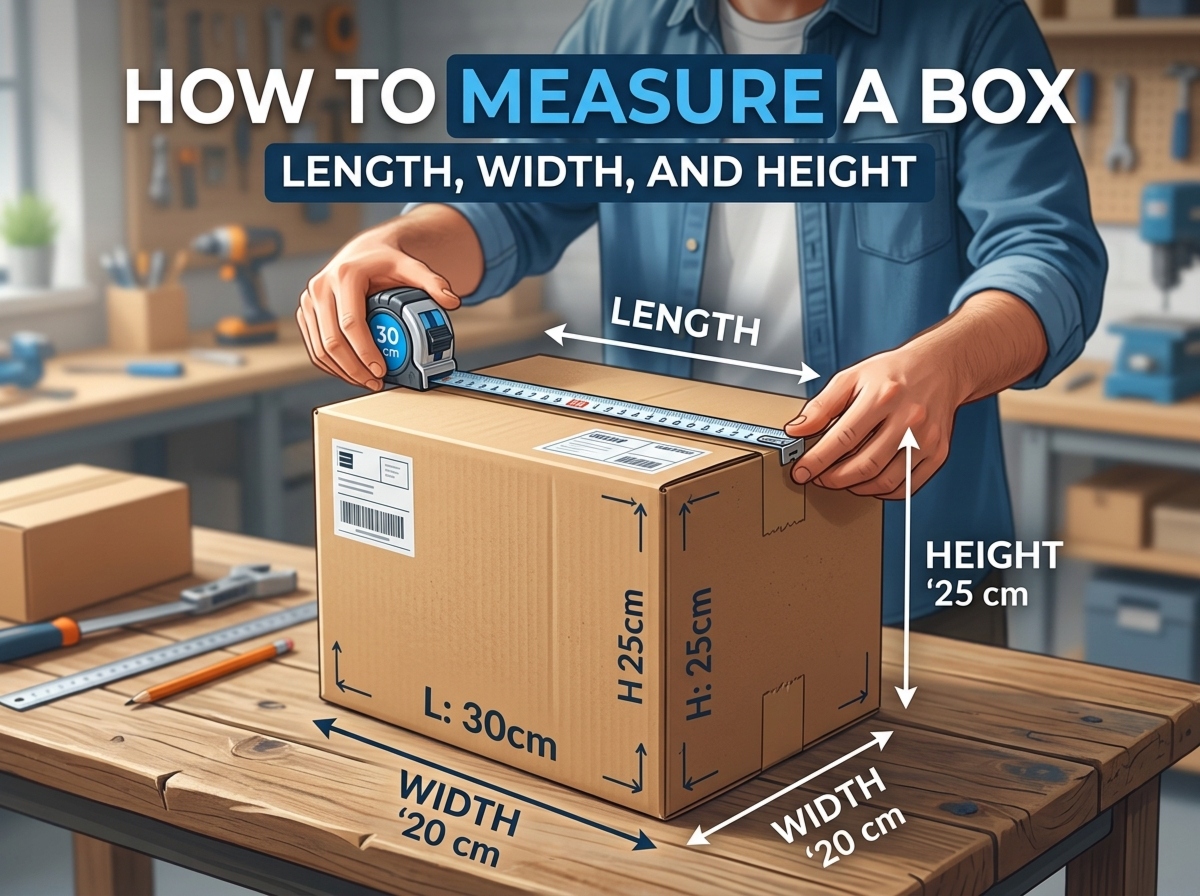
To measure a box correctly, record the length, width, and height. These three measurements, also known as box measurements/dimensions, describe the size of a box or package. Getting these right is more important than most people think, as these measurements affect shipping costs, storage, and product protection. This article will explain how to measure boxes, what tools and units to use, how to write measurements correctly, when to use external and internal measurements, how to calculate dimensional weight and box volume, and tips for measuring different types of packaging.
What Are Box Measurements?
Box measurements are the dimensions that specify the size of a box.
Box measurements/dimensions consist of the following measurements:
- Length (L) is the longest side of the box.
- Width (W) is the shorter side of the box.
- Height (H) is the vertical distance from the base to the top.
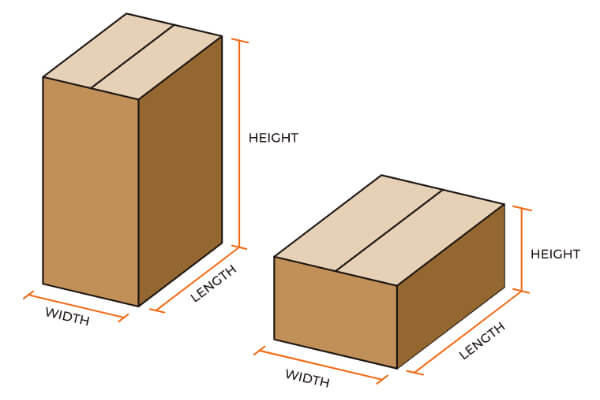
Standard box measurement points
How to Write Dimensions in the Right Order
Length x Width x Height (L × W × H) is the standard order in which dimensions are written. This layout is used by manufacturers, suppliers, and shipping carriers worldwide and helps avoid confusion between them. In some cases, height may be written as depth (D) instead.
For instance, a box with dimensions of 18 × 12 x 9 inches has a length of 18, a width of 12, and a height of 9 inches.
Use the Right Unit to Write the Dimensions
The units are just as important to get right as measuring the box itself. Inches (in) and centimeters (cm) are the standard units used to describe the size of a box. Which one to use depends on location. In the U.S., domestic carriers such as USPS, FedEx, and UPS work in inches, so for American customers or shipments within the U.S., use inches. For consumers or manufacturers outside the U.S., use centimeters, since that is the preferred standard.
For reference, 1 inch = 2.54 centimeters and 1 centimeter = 0.39 inches.
Should I use Internal or External Measurements?
For packaging manufacturer communication, use internal measurements to ensure the product fits and is protected during shipping. Internal measurements describe the actual usable space inside the box.
The difference between external and internal measurements is as follows:
The main difference between external and internal measurements is the thickness of the box walls. The internal measurements do not include the thickness of the box walls and only measure the space inside the box. In contrast, external measurements do include the thickness of the walls. This means that external measurements reflect the actual size of the whole box which is larger than internal measurements.
External and internal measurements are used for different purposes: External measurements are used by shipping carriers and warehouses to accurately calculate freight charges, pallet fit, and storage needs. This is because shipping carriers calculate their shipping costs based on the space a package takes up. Internal measurements make sure the product fits properly in the box, which also helps protect products. This is because internal measurements measure the actual available space inside the box, therefore, this measurement can be used to ensure the product fits well without too much movement during transit. This reduces the risk of damage, especially for fragile items.
Use the Right Tools for Measuring
Different types of packaging require different tools to measure them accurately.
Here is a list of different measuring tools and when to use them:
- Tape measure or steel ruler: For measuring general box dimensions (length, width, and height).
- Calipers: For measuring thickness of box walls, or the diameter of tubes and inserts.
- Measuring cube or volume calculator: For measuring odd-shaped packages, where standard box dimensions may not be accurate.
Tip: Place the box on a flat surface for more precise measurements.
Tips for Measuring Different Types of Packaging
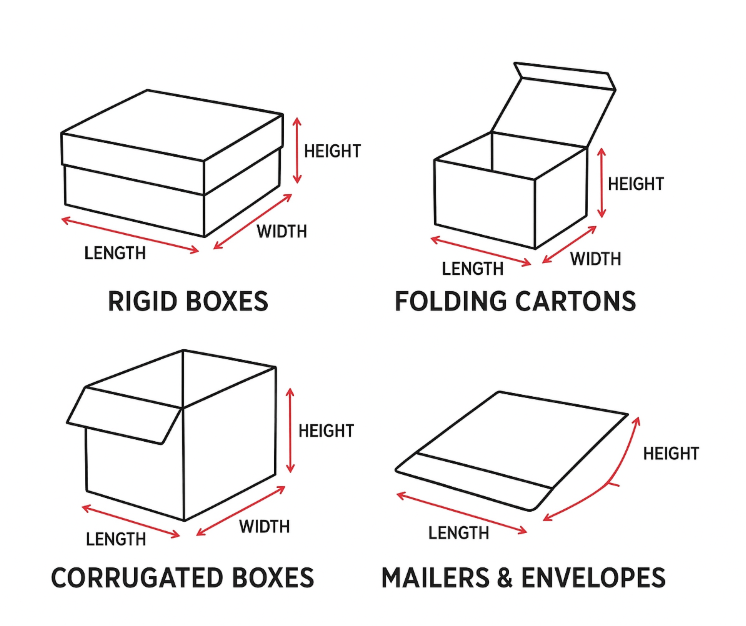
This diagram shows where to measure each type of packaging (rigid boxes, folding cartons, corrugated boxes, and mailers & envelopes)
Rigid boxes
Here are tips for measuring rigid boxes:
- Measure the lid and base separately, especially for “shoulder” or “neck” boxes.
- Include lid depth: A small miscalculation here can make the box hard to open or too loose.
- If your box will have a foam or paperboard insert, measure that as well.
Folding cartons
Here are tips for measuring folding cartons:
- Assemble a sample before measuring — Flat measurements alone can be misleading.
- Double-check glue flaps and folds; they affect the usable space.
- Use millimetres for more accuracy, especially for small cartons.
- If you’re ordering custom printing, give your supplier both the assembled size and the flat size for the dieline.
Corrugated Boxes
Here are tips for measuring corrugated boxes:
- Account for wall thickness — Double-wall boards add more to the size.
- Leave space for protective packaging like bubble wrap or inserts.
- For shipping purposes, carriers like USPS, FedEx, and UPS use the exterior dimensions to calculate costs. Measure the outside for your shipping label.
Mailers & Envelopes
Here are tips for measuring mailers and envelopes:
- List Width × Height, and if there’s a gusset, include it separately.
- Subtract the sealing flap area when calculating usable space.
How to Calculate the Volume of a Box?
Box volume is the total space inside the box.
The formula to calculate box volume is:
Volume (V) = Length (L) x Width (W) x Height (H)
Example calculation:
If your box is 10 inches long, 5 inches wide, and 4 inches high:
Volume = 10 × 5 × 4 = 200 cubic inches.
Calculating volume is important for several reasons. The volume helps determine how much product or fill material can fit inside a box. Also, the volume can be used to estimate shipping costs or storage space requirements. Furthermore, the volume helps in comparing package options.
What is the Dimensional Weight?
Dimensional weight is a pricing technique used by shipping carriers based on the volume of a package. This technique is commonly used in logistics, fulfillment services, and e-commerce.
Dimensional weight is calculated based on box volume to reflect the space a package occupies in transit, whereas actual (gross weight) is the physical weight of the box.
The standard carrier formula is as follows:
DIM Weight = (L x W x H) / DIM Factor, where length, width, and height are measured in inches and DIM Weight is measured in pounds.
The typical DIM factor is 139; however, this can vary by carrier (FedEx, UPS, DHL, and USPS each have their own carrier pricing policies)
For example, if your package’s actual weight is 16.2 lbs, but the box has measurements of 20 × 12 × 10 inches,
Box volume = 2,400 cubic inches.
DIM Weight = 2,400/139 ≈ 17.27 lbs
17.27 lbs > 16.2 lbs
Since 17.27 lbs is greater than 16.2 lbs, the freight calculation will be based on 17.27 lbs.
Why Correct Packaging Measurements Saves Time and Money
Correct packaging measurements can save time and money by:
1. Reducing DIM weight shipping fees – Accurate measurements prevent overcharging by inflated DIM weight calculations.
2. Preventing product damage and returns – Packaging that fits the product securely reduces unnecessary movement during transit, lowering the risk of damage.
3. Communicating efficiently with manufacturers – Manufacturers can produce boxes that fit products perfectly when given the correct measurements.
Witpax Can Help Get Your Measurements Right
At Witpax, we make sure your packaging is correct by:
- Free dieline creation tailored to your product specifications.
- Measurement verification before production.
- Prototyping and fit testing to avoid costly mistakes.
- Guidance on how to reduce shipping costs through right-sized packaging
📩 Need help measuring your packaging? Send us your product dimensions, and we’ll give you a free dieline within 48 hours.