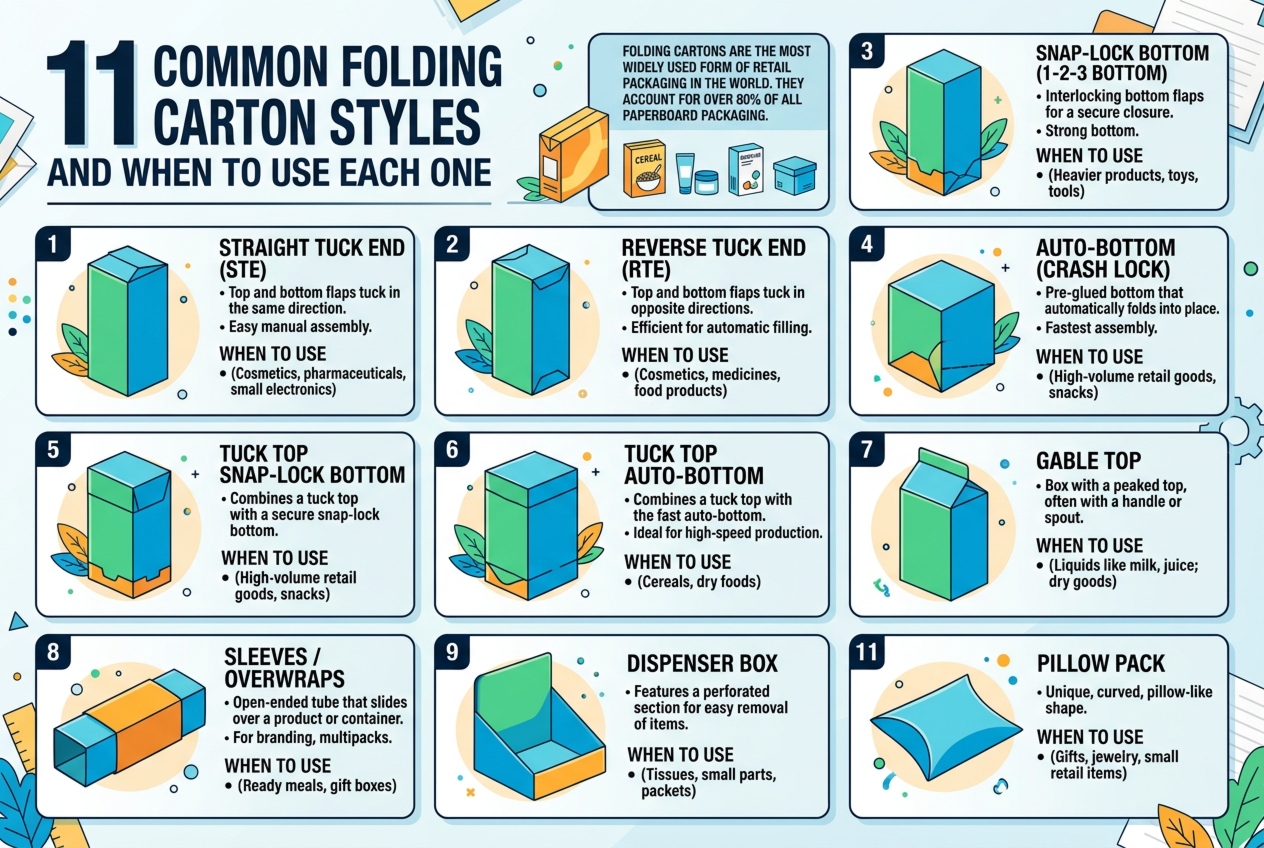
Folding cartons are the most widely used form of retail packaging in the world. They account for over 80% of all paperboard packaging. You see them every day—cereal boxes, cosmetic containers, medicine packaging, and electronics boxes all use folding carton structures.
But not every folding carton works the same way. Each style has a different closure mechanism, a different level of structural strength, and a different cost profile. Choosing the wrong style means you pay more than you need to, or worse, your product gets damaged.
This guide breaks down 11 common folding carton styles, explains how each one is built, and shows you exactly which products and industries each style fits best.
What Makes Folding Cartons the Default Packaging Choice
A folding carton is a box made from a single sheet of paperboard. The sheet gets printed, die-cut, scored, folded, and glued into a flat blank. That blank ships flat to the product manufacturer, who pops it open and fills it on the packaging line.
This flat-pack design is the main reason folding cartons dominate retail packaging. Shipping flat blanks instead of assembled boxes cuts freight volume by 70–80%. You store thousands of cartons in the same space that would hold a few hundred rigid boxes.
Folding cartons also print beautifully. The smooth paperboard surface takes offset, digital, and flexographic printing with sharp detail and accurate color. You can add finishes like matte or gloss lamination, foil stamping, embossing, and spot UV to build a premium look without the premium price.
On the sustainability side, folding cartons check every box. Paperboard comes from renewable wood fiber. Most cartons use FSC-certified or recycled material. The recycling rate for paperboard in the United States sits above 60%—far higher than plastic packaging.
Two main material categories exist. Paperboard folding cartons use a single layer of board, typically 250–600 GSM. They suit most retail products. Corrugated folding cartons sandwich a fluted layer between two liner sheets, adding extra crush resistance for heavier items or shipping applications.
Tuck End Cartons: The Foundation of Folding Carton Packaging
Tuck end cartons are the most common folding carton family. They close using flaps—called tucks—that fold into the box and hold the ends shut. No tape, no glue, no extra tools. You just tuck the flaps in, and the box is sealed.
The differences between tuck end styles come down to two things: which direction the flaps fold, and which panel they attach to. These small structural changes affect cost, appearance, and how well the box protects your product.
1. Straight Tuck End (STE) — Clean Front Face for Shelf Impact
The straight tuck end box has both top and bottom closure flaps on the same side of the carton. Both flaps fold from front to back in the same direction. Most STE cartons include slit locks—small cuts that grip the tuck flap and hold it in place.
The key advantage of an STE is its clean front panel. Because both tuck flaps fold behind the front face, no raw edges or flap seams show on the display side. This gives brands an uninterrupted canvas for graphics, logos, and product information.
Best for: Cosmetics, skincare, supplements, essential oils, CBD products, and any lightweight retail item where shelf appearance drives purchase decisions.
Watch out: STE blanks do not nest as tightly on a press sheet as reverse tuck blanks. This means slightly more paper waste per unit, which pushes the cost per piece a bit higher than an RTE.
2. Reverse Tuck End (RTE) — Cost-Optimized for High-Volume Runs
The reverse tuck end box looks almost identical to the STE, but the closure flaps are on opposite sides. The top flap folds from front to back, while the bottom flap folds from back to front. This opposite-direction arrangement gives the style its name.
From a manufacturing perspective, RTE blanks nest more efficiently on the printed sheet. You fit more cartons per sheet, which reduces material waste and lowers the unit cost. For brands running high volumes, this cost difference adds up fast.
The trade-off is a visible seam where the tuck flap meets the box edge on the front panel. It is a minor cosmetic issue, but it matters for luxury or high-end positioning. For most mid-range products, the savings outweigh the visual compromise.
Best for: Pharmaceuticals, electronics accessories, personal care products, vape cartridges, and any product where cost efficiency matters more than a flawless front face.
Key difference from STE: Lower cost per unit, slightly less refined front appearance, and a more tamper-resistant closure since the opposing tuck directions make the box harder to accidentally open from the bottom.
3. French Reverse Tuck (FRT) — Premium Closure for High-End Brands
The French reverse tuck is a refined version of the standard reverse tuck. The top closure hinges from the front panel and tucks toward the rear. The bottom closure hinges from the rear panel and tucks toward the front. Both flaps tuck inward, creating a double-layer closure on each end.
This double tuck-in design produces a noticeably polished finish. The edges look cleaner. The closure feels more secure. And the box provides better dust and moisture protection compared to standard tuck ends.
FRT cartons typically use a combination of slit lock and friction lock closures. Some use slit locks on both ends. The choice depends on how often the consumer opens and closes the box.
Best for: Cosmetics, fragrances, premium food packaging, and pharmaceutical products where a finished, upscale appearance is part of the brand experience.
Bottom-Lock Cartons: Structural Strength Without Tape or Glue
When a product weighs more than a couple of pounds, standard tuck flaps at the bottom cannot support it reliably. The flaps may pop open during shipping or when the consumer picks up the box. Bottom-lock cartons solve this problem with mechanical locking systems that hold the base shut under load.
4. Auto-Lock Bottom (Crash Bottom) — The Strongest Folding Carton
The auto-lock bottom box has a pre-glued base that snaps into place automatically when the carton is erected. You push the side panels open, and the bottom crashes down into a locked position. No manual folding of base flaps is required.
This makes the auto-lock bottom the strongest folding carton style available. The pre-glued base panel distributes weight evenly, and the locked structure resists lateral pressure. It handles heavy, dense, or awkwardly shaped products that would crush a standard tuck bottom.
The downside is cost. Auto-lock bottoms require an extra gluing step during manufacturing, which adds time and expense. But for heavy products, the reliability justifies the investment.
Best for: Wine and spirits bottles, large candles, glass jars, heavy cosmetics containers, and pharmaceutical products that require a stable, load-bearing base.
5. Snap Lock Bottom (1-2-3 Bottom) — The Middle Ground Between Strength and Cost
The snap lock bottom box—also called a 1-2-3 bottom or lock bottom box—gets its name from the three steps needed to assemble the base. You fold one flap, then the second, and the third snaps into place, locking all three together.
This interlocking mechanism creates a sturdy base that handles heavier loads than tuck ends but costs less than auto-lock bottoms. The base sits flat on retail shelves, which makes the box ideal for point-of-sale displays.
Assembly is quick even by hand. In high-volume settings, it does not slow the packaging line significantly compared to simpler styles.
Best for: Craft beer and spirits, large electronics accessories, heavy candles, and any product in the 1–5 pound range that needs a reliable base without the premium price of an auto-lock design.
Sealed and Tamper-Evident Cartons: Protection Consumers Can Trust
6. Seal End Carton — Glued Closures for Maximum Security
A seal end carton has both ends glued or heat-sealed shut after the product is placed inside. There are no tuck flaps to open and close. Once sealed, the only way to access the product is to tear or cut the carton open.
This makes seal end cartons inherently tamper-evident. If someone opens the box, the damage is visible. For food and pharmaceutical products, this feature is not optional—it is a regulatory and consumer trust requirement.
Seal end cartons work well with high-speed automated packaging lines. The sealing equipment applies adhesive or heat quickly and consistently, maintaining throughput on fast production runs.
Best for: Frozen foods, cereals, snack bars, over-the-counter medications, medical devices, and any product where tamper evidence and automated packing speed are top priorities.
Limitation: Consumers cannot reseal the box after opening. If your product requires repeated access—like a snack box that gets opened and closed multiple times—a tuck end style is a better fit.
Display and Retail-Optimized Cartons: From Shelf to Point of Sale
7. Five-Panel Hanger Box — Built-In Retail Display Hook
A five-panel hanger box is a reverse tuck end carton with an extra panel extending from the back. This panel has a hole punched through it, allowing the box to hang on a peg hook or display rack in a retail store.
The hanger panel eliminates the need for separate hang tags or display hardware. The product arrives ready to hang. This simplifies retail stocking and keeps your packaging clean and professional.
Best for: Small electronics, accessories, sample-sized personal care products, and any lightweight product sold in peg-hook retail environments.
8. Counter Display Box (Pop-Up Box) — Packaging and Merchandising in One
A counter display box serves two functions. When closed, it protects and transports the product like any other carton. When the lid opens, it folds back to become a display header, turning the box into a countertop merchandising unit.
Some designs include perforated tear-away panels that convert the shipping carton into a permanent display tray. Others use a simple fold-back lid with printed branding and promotional messaging.
Best for: Sample packs, impulse-buy items, seasonal promotions, small confectionery products, and any product that benefits from point-of-sale visibility without requiring a separate display fixture.
Specialty Carton Styles: Beyond the Standard Box
9. Sleeve Carton — Minimal Material, Maximum Branding Flexibility
A sleeve is the simplest folding carton style. It has no top and no bottom—just an open-ended tube of printed paperboard that slides over another box or product. Think of the decorative wrap around a two-piece gift box or the branded band around a soap bar.
Because sleeves use less material than any other folding carton type, they are the cheapest to produce. They also offer an easy way to update packaging graphics without redesigning the inner box. Run a holiday promotion? Print a seasonal sleeve and slide it over your existing packaging.
Best for: Bundling multi-packs, adding seasonal or promotional messaging, upgrading plain inner boxes, and wrapping products like soaps, candles, and chocolate bars.
10. Two-Piece Tray and Lid Box — Double-Wall Protection for Premium Products
A two-piece box consists of a separate tray (bottom) and lid (top) that fit together. When assembled, the overlapping walls create a double-layer structure that provides more protection and rigidity than single-wall cartons.
This style communicates quality. The act of lifting a lid to reveal the product inside creates an unboxing moment that single-piece cartons cannot replicate. It is one reason why jewelry, confectionery, and apparel brands prefer this format for retail packaging.
The trade-off is production time and cost. Manufacturing two separate components takes longer and uses more material than a single-piece carton. Two-piece boxes also take up more storage space before assembly.
Best for: Jewelry, baked goods, clothing, luxury gift items, and any product where the unboxing experience is part of the brand value proposition.
11. Gable Top Carton — Pour-and-Carry Design for Beverages
The gable top carton features a triangular peaked top with a built-in carry handle. You see it most often in the dairy and juice aisle. The peaked shape channels liquid flow for clean pouring, and the handle makes the container easy to grip and carry.
Gable top cartons require specialized forming and filling equipment, which limits their use to dedicated beverage or liquid packaging lines. But for products that fit this format, the structural stability and consumer convenience are hard to beat.
Best for: Milk, juice, wine, soups, and other pourable liquids where a built-in handle and controlled pour spout improve the consumer experience.
Folding Carton vs. Rigid Box vs. Corrugated Box: A Quick Comparison
Folding cartons are not the only packaging option. Rigid boxes and corrugated boxes each serve different needs. The comparison below shows how the three formats stack up across the factors that matter most.
| Factor | Folding Carton | Rigid Box | Corrugated Box |
| Material Thickness | 250–600 GSM (single layer) | 800–1500 GSM (chipboard) | Multi-layer fluted board |
| Structural Strength | Moderate | Very high | High |
| Unit Cost | Low to moderate | High | Low to moderate |
| Ships Flat? | Yes | No (pre-assembled) | Yes |
| Print Quality | Excellent | Excellent (wrapped) | Good (limited detail) |
| Sustainability | Highly recyclable | Reusable but complex to recycle | Highly recyclable |
| Best For | Retail, cosmetics, food, pharma | Luxury, jewelry, electronics | Shipping, heavy items, e-commerce |
Folding cartons hit the sweet spot for most consumer products. They offer enough protection for items on retail shelves, excellent print quality for branding, and the lowest logistics cost thanks to flat-pack shipping. Rigid boxes step up for luxury and high-value items. Corrugated boxes handle shipping and heavy-duty protection.
How to Choose the Right Folding Carton Style for Your Product
With 11 styles to consider, narrowing down the right one comes down to five questions.
1. How heavy is your product? Products under one pound work well with tuck end styles (STE, RTE, FRT). Products between one and five pounds need a snap lock or auto-lock bottom. Anything heavier should use corrugated or rigid packaging.
2. Does your product need tamper evidence? If yes, seal end cartons are the standard. They meet regulatory expectations in food and pharmaceutical packaging and give consumers visible proof that the product has not been opened.
3. How will the product be displayed at retail? Peg-hook displays call for a five-panel hanger box. Countertop impulse buys benefit from counter display boxes. Standard shelving works with any tuck end or bottom-lock style.
4. How important is the front-face appearance? If your brand depends on clean, uninterrupted graphics on the front panel, choose an STE or FRT. If cost savings matter more, an RTE delivers the same structure at a lower price.
5. What volume are you producing? High-volume runs favor RTE and auto-lock bottom styles because they integrate well with automated packaging lines. Lower-volume specialty runs may use FRT or two-piece boxes where the extra per-unit cost is justified by the premium positioning.
If you are still unsure which style fits, the simplest approach is to start with product weight and fragility, then layer in display requirements and branding goals. A packaging specialist can help you match these priorities to the right structure.
Customization Options That Elevate Any Folding Carton Style
Every folding carton style in this guide can be customized. The base structure is just the starting point. What you add on top determines how the box looks, feels, and performs.
Material choices: SBS (solid bleached sulfate) gives you a bright white surface ideal for vivid printing. Kraft paperboard delivers a natural, eco-friendly look. Recycled board supports sustainability goals. Food-grade and pharmaceutical-grade boards meet strict regulatory standards.
Surface finishes: Gloss lamination makes colors pop and adds scratch resistance. Matte lamination creates a sophisticated, understated feel. Soft-touch lamination adds a velvety texture that consumers notice the moment they pick up the box.
Decorative effects: Foil stamping adds metallic accents in gold, silver, or custom colors. Embossing raises logos or patterns for a tactile element. Debossing presses designs into the surface. Spot UV applies a glossy highlight to specific areas of a matte background, creating visual contrast.
Functional features: Window cutouts let consumers see the product inside without opening the box. Thumb tabs make it easier to open the carton. Custom inserts hold products securely in place and enhance the unboxing experience. Hang tabs add retail display capability to any style.
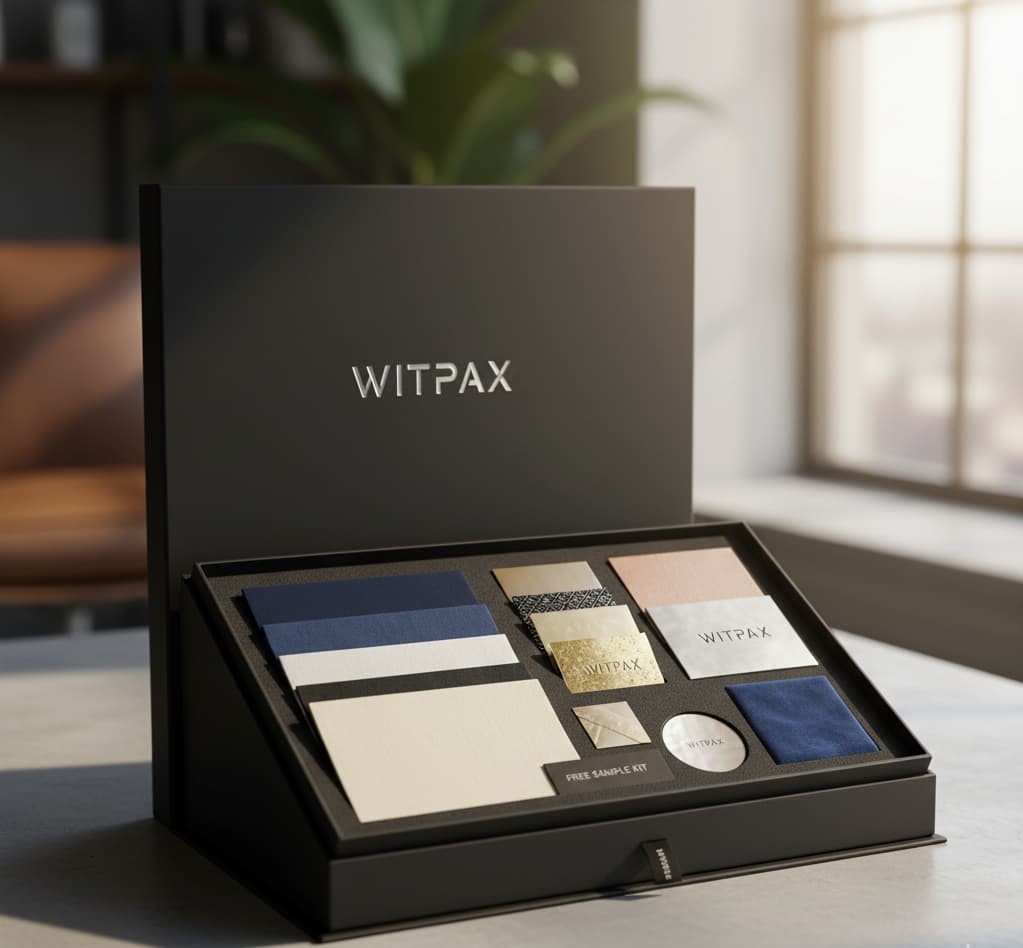
The right combination of these options turns a standard folding carton into a brand-building tool. At WITPAX, every folding carton project starts with a consultation to match structure, material, and finish to the specific needs of your product and market.
Frequently Asked Questions
Are folding cartons recyclable?
Yes. Folding cartons are made from paperboard, which is one of the most widely recycled materials in the world. In the United States, paperboard has a recycling rate above 60%. As long as the carton is clean and free of heavy contamination, it can go into standard curbside recycling programs.
What materials are used for folding cartons?
The most common material is solid bleached sulfate (SBS), a white paperboard with a smooth surface that prints well. Kraft paperboard offers a natural brown look and strong fiber structure. Recycled paperboard uses post-consumer waste and supports sustainability positioning. For food and pharmaceutical applications, certified food-grade or medical-grade boards are available.
What is the difference between paperboard and corrugated cartons?
Paperboard cartons use a single layer of board. They are lightweight, print beautifully, and work well for retail shelf products. Corrugated cartons have a fluted inner layer sandwiched between two flat liner sheets. This layered structure adds crush resistance and shock absorption, making corrugated better for shipping and heavier items.
How are folding cartons manufactured?
The process follows a consistent sequence. First, the box design is translated into a die-line—a flat template showing all panels, flaps, and fold lines. The paperboard is then printed using offset, digital, or flexographic presses. After printing, a die-cutting machine stamps out the carton blank. The blank is scored along fold lines, then folded and glued into its final flat shape. These flat blanks ship to the product manufacturer for erection, filling, and closing on the packaging line.
What industries use folding carton packaging the most?
Food and beverage is the largest market for folding cartons, followed by cosmetics and personal care, pharmaceuticals and healthcare, consumer electronics, and retail goods. The format works across nearly every consumer product category because of its flexibility in size, structure, and print quality.
Can I create a custom carton shape that is not one of these 11 styles?
Absolutely. Custom dies can produce virtually any shape, size, or structural configuration. Hexagonal boxes, curved panels, integrated compartments, and custom locking mechanisms are all possible. If a standard style does not fit your product, a packaging manufacturer can develop a custom die-line from scratch.
Choosing the Right Folding Carton Starts with Understanding Your Product
Every folding carton style in this guide exists because it solves a specific packaging problem. Straight tuck ends maximize shelf appeal. Auto-lock bottoms support heavy products. Seal end cartons provide tamper evidence. Sleeves add branding flexibility at the lowest material cost.
The best choice is the one that matches your product’s weight, your retail display requirements, your branding goals, and your production volume. Start with those four variables, and the right style becomes clear.
If you need help evaluating which folding carton style works best for your product line, WITPAX offers free packaging consultations. Our team can walk you through structural options, material choices, and finishing techniques to find the combination that protects your product and elevates your brand.